An Introduction to Relational Literacy

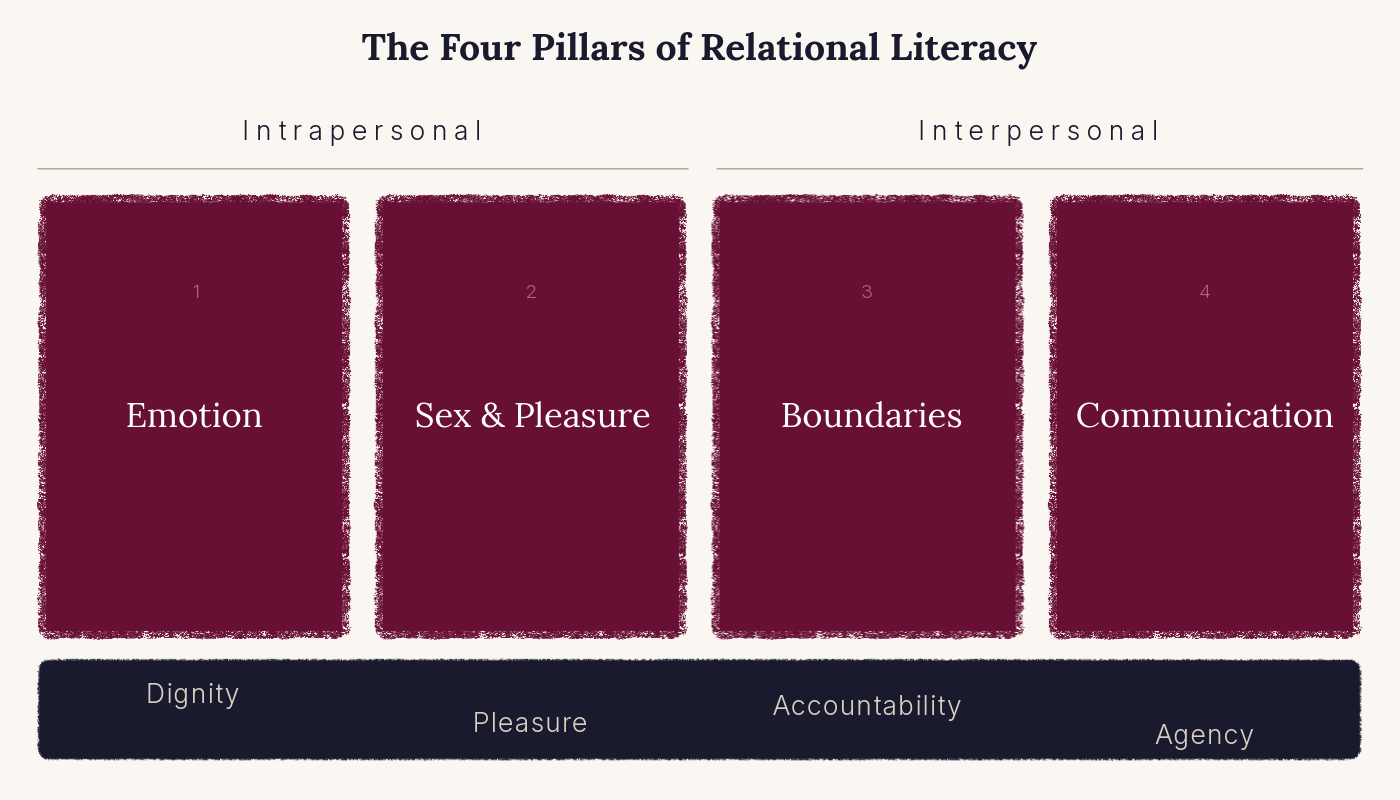
Relational Literacy is a framework and curriculum that emerged from decades of personal and professional experiential research. The four pillars are Emotion, Sex & Pleasure, Boundaries, and Communication. It is a literacy because these capacities work the way language does—universal, and dependent on modeling, instruction, and practice.
Most of us were never taught to navigate our emotional landscape, to understand what sex means and how to talk about it, to hold our limits without sacrificing connection, or to move through conflict generatively. The capacity is hardwired, but its development gets arrested by inadequate modeling, by systems that disrupt intimate and social bonds, and for many of us by direct harm.
Inherent capacity gets misshapen without accurate, meaningful instruction. Interrupted development transmits generationally. We model what we are taught, and we teach what we model. Illiteracy transmits. And so does literacy. As foundational instruction this framework is formative; as reparative instruction it is restorative.
The Architecture
The pillars are relational capacities and relational necessities. Without them we are diminished: in access to our own interiority and in what becomes possible between us.
The principles are dignity, pleasure, accountability, and agency. Disciplines we practice, not states we reach.
Emotion and Sex & Pleasure form the intrapersonal axis. Each resets our relationship to ourselves, re-asserting dignity and pleasure as vital, not earned but tended. Uprooting internalized shame and judgment, pivoting our internal narrative toward curiosity and self-acceptance: this is the ground from which we engage what follows, from wholeness not deficit.
Boundaries and Communication form the interpersonal axis, where capacity turns outward. Knowing what we want is one thing; getting it is a negotiation with reality and with other people. Accountability and agency are the necessary scaffolding for resilient, collaborative relating.
The transformed relationship isn't a vehicle for justice: it is justice. Not the absence of harm but the presence of a thriving sense of self and of generative connection. Intimate Justice makes this argument.
The Sequence
Emotion is foundational. The order that follows is pedagogical. Each pillar develops the others.
Emotion as Foundation
Emotional literacy reasserts felt information as intelligence. Emotion is somatic before it is anything else—the body feels, and the mind brings the vocabulary.
It develops the language for our emotional experience, and slows us down so that we can recognize what we're feeling when we're feeling it. It inserts a beat, a pause between stimulus and reaction so that we can attend and tend to the feeling, and then respond. Once we accept that emotion is a constant, that all emotions are both value neutral and valuable—not good, not bad, but intrinsic to the landscape of being human—we can engage our agency in how we experience and express our feelings. This is where literacy graduates to fluency, what lets us stay with the intense terrain, not only the preferred or prescribed.
Sex & Pleasure as Reclamation
This pillar is the hinge of the curriculum. It requires every other pillar and develops them in turn.
Sex and pleasure both derive from the erotic, our inherent creative drive. Knowing and having access to what is pleasurable—what enlivens us, lights us up, and turns us on—requires emotional fluency. Good sex requires erotic intelligence, the ability to navigate boundaries and communicate complexity and ambiguity. And because sex and pleasure are still taboo, this is where those literacies bear the most weight: where being with intensity, being with disappointment, and communicating under pressure all come together.
Without erotic intelligence we navigate desire from an external locus of control and the limited menu of options that culture prescribes and proscribes, focused on what we should want, performing what's expected, and overriding any misalignment this causes.
Sex is a felt experience and there is no getting around that. Even when it is about achieving orgasm, or giving a good performance, at the root of both is something felt. The first is embodied—physical release, physiological climax. And the second is emotional—the pull to feel something: competent, in control, accepted. Severed from the erotic, focus on mechanics and performance flattens sex into a task. Connected to the erotic, sex becomes a site of genuine exploration and discovery.
Boundaries as Infrastructure
Boundaries are the infrastructure of intimacy, what supports true interdependence, neither codependent nor hyper-individualistic. Relational boundaries are the complex, nuanced interplay of our needs and limits, desire and capacity. This pillar draws directly on the intrapersonal axis, where emotional and somatic fluency give us access to the felt information that informs what we need, what we want, where our limits are.
When our boundaries align, we move together easily and there's nothing to negotiate. Misalignment is where most of us run out of moves. What's available and lauded is the sacrifice and compromise model—both based on the premise that one person's truth has to give way. Sacrifice asks a truth to be nullified. Compromise asks it to be diminished. But the truth of a person's experience can't be negotiated. Arrangements can be. Each person's needs, desire, limits, and capacity are real and stay real.
We will not always get what we want, and that is survivable. What robust boundaries make possible is that none of it requires coercion or capitulation to stay connected. We can accept a no, and believe a yes. Difference can be embraced rather than managed, and we can each be whole in our connections.
Communication as Collaboration
Communication is where and how everything that comes before gets expressed. It is the most practice-based pillar, and it solves for a problem most of us don't know we have: we think we are having rational conversations when we are actually having emotional ones. Without models for how to communicate when feeling takes over, we stumble through felt terrain with only technique and rationality for guides, and wonder why our hardest conversations keep failing. And they do more than fail. Repeated activation without the tools to navigate and metabolize challenging experience compounds the injury it can't resolve.
The Rules of Engagement is a formal structure for emotion-centered conversation. The Container, in shorthand, develops our ability to stay present to our own experience and that of the other person without conflating the two. It begins with small, specific constraints: state a feeling without explaining or justifying it, say back what was actually said rather than the interpretation, hear a feeling without reassuring or fixing.
I developed it in practice and have taught it for years. It reliably helps us move through conflict, repair after rupture, expand mutual understanding, and collaborate on problems both relational and logistical.
Literacy is acquired. We learn to read because someone literate teaches us, and we become fluent by our own reading. These capacities develop the same way, through modeling, instruction, and practice. The four pillars are not four subjects. They are one literacy, and we are always somewhere in it.
No one is born unable to relate. The capacity is there. When it goes untaught, or gets taught wrong, we don't lose it. Development that was interrupted can resume, at any age, in any relationship.
And literacy transmits. We model what we are taught and we teach what we model, so it moves through every relationship we are in. Not through what we explain, but through what we practice: how we handle disappointment, how we hold a limit and stay in connection, whether rupture is followed by repair.
None of this waits on being finished. It begins wherever we are.
The revolution is relational.
Member discussion